
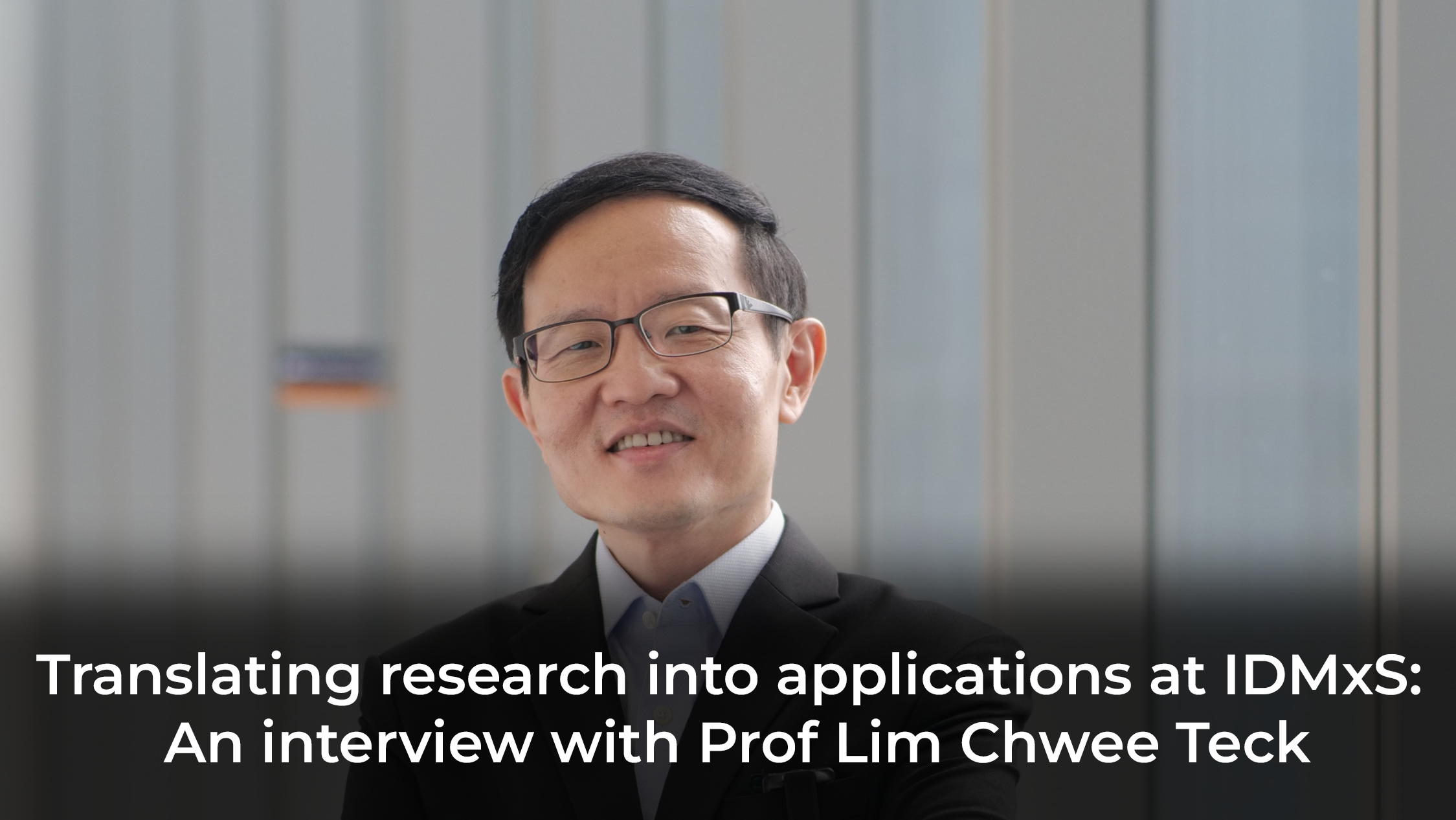
Biography: Professor Lim Chwee Teck is a Principal Investigator in the Translation Cluster at IDMxS. He is the inaugural NUSS chair Professor at the NUS Department of Biomedical Engineering. He is also the Director of the Institute for Health Innovation and Technology (iHealthtech) and the Founding Director of the Singapore Health Technologies Consortium.
Prof Lim’s interdisciplinary research interests include human disease mechanobiology and microfluidic and wearable sensing technologies for healthcare applications.
Prof Lim completed his PhD at Cambridge University after graduating with a BEng in Mechanical Engineering from the National University of Singapore. Among his many prestigious accolades, he was recently elected as a Fellow of the Royal Society.
What initially sparked your interest in biomedical applications and molecular analytics?
Prof Lim: I am a mechanical engineer by training and completed my PhD in mechanics at Cambridge, and not in molecular analytics. However, upon returning to Singapore right after my PhD, I was appointed as an Assistant Dean at the National University of Singapore (NUS). One of my initial tasks was to assist in establishing the NUS Bioengineering Programme.
This role really threw me into the deep end of biology and medicine—areas I had limited knowledge in at the time. But it turned out to be a fascinating experience. I became genuinely intrigued by the idea of applying my mechanical engineering skills to these new fields. It was exciting to think about how my expertise could help address some of the challenges in medicine.
While I knew that biomechanics was an existing field, I wanted to take a fresh approach, using mechanics to uncover the underlying causes of certain diseases such as malaria and cancer. So, I started leveraging my engineering background not only in studying diseases, but also leverage on new knowledge gained to develop novel devices for better disease diagnosis and therapy. It’s been a rewarding journey so far to see how my skills can make a difference in these critical areas. Recently, I have moved into exploring the use of aptamers as a form of molecular analytics in disease detection and diagnosis.
What areas of research are you exploring at IDMxS?
Prof Lim: At IDMxS, we’re exploring how electrochemical methods can be used to diagnose diseases. We’re specifically focusing on developing sensors that combine aptamers with electrodes. Aptamers are single-stranded RNA or DNA sequences designed to bind to specific targets. When an aptamer binds to its target, it undergoes a conformational change that alters the current, potential, or impedance of the sensor, allowing us to detect the presence of the target.
Right now, we’re applying this technique to monitor wounds. Our sensors can be placed on a patient’s wound to quickly and remotely assess whether it’s healing properly or if there’s an infection. We’re excited to be moving towards commercializing this technology through a startup collaboration between IDMxS and NUS, with plans to launch within the following year.
What motivated you to join IDMxS?
Prof Lim: When I joined IDMxS as a collaborating PI from NUS, I was excited to dive into the Institute’s diverse range of expertise. My goal has been to enhance the precision of aptamer sensing technology here, aiming to detect even single molecules. The fantastic collaborators at IDMxS, along with the top-notch facilities and support, have been instrumental in advancing my research. I’m particularly enthusiastic about exploring our electrochemical approach to tackle other diseases, like flu viruses and even cancer.
What advice do you have for translating research into real-world solutions?
Prof Lim: We always start by talking directly to the end users—in our case, the clinicians. Our approach is to deeply understand their needs and challenges so that we can tailor our solutions to be more user-friendly in a clinical setting. When we develop solutions that meet their needs, clinicians are more likely to advocate for and use them.
This user-centric approach helps address one of the major challenges of translating technology from the lab to real-world applications. Another key challenge is ensuring that the technology is intuitive and easy for both clinicians and patients to use, so we make usability a priority from the start. Additionally, we consider scalability early in the design process to ensure that the technology can be produced more cost-effectively in the future.
What do you think is unique about IDMxS?
Prof Lim: IDMxS is uniquely equipped to tackle some of today’s most pressing challenges. These problems we’re addressing, such as those in healthcare, are incredibly complex, requiring expertise from multiple fields. That’s why the diverse expertise and collaborative spirit at IDMxS are so crucial—they enable us to navigate these challenges effectively and innovatively.
What are the next steps for your research?
Prof Lim: At IDMxS, our electrochemical sensor represents a versatile platform technology with the potential to detect a range of diseases, including cell-free circulating tumour DNA. These biomarkers, found in blood, are released from lysed cancer cells. We’re working on adapting our technology to identify these circulating tumour DNA markers, focusing initially on lung cancer and specific drug-resistant mutations.
By detecting these mutations quickly—within just 15 minutes—our technology offers a more efficient and cost-effective alternative to traditional sequencing tests. This allows for rapid adjustments in medication to target these mutations more precisely, a process we refer to as precision therapy.
Do you have any advice for young researchers entering this field?
Prof Lim: For young researchers, embrace curiosity, persistence, and a willingness to learn. Collaborate, seek mentorship, and stay updated on advancements in your field. Ask important scientific questions and work on something that not only motivates you, but which will also benefit the society. Treat setbacks as learning opportunities, explore interdisciplinary approaches, and stay passionate.
Click here to learn more about our research and how we are unlocking the power of every molecule in the digital age.