
Dr Samsher Singh and Aparna Gollapudi
A new experimental drug has been discovered that doesn’t just attack Mycobacterium tuberculosis alone, it works together with telacebec (a clinical candidate) to ensure the bacterium is left with lesser survival strategies!

Tuberculosis (TB) remains one of the world’s deadliest infectious diseases with more than 10 million people developing TB and over a million dying in 2023. This is largely because the underlying bacteria are masters of survival, making treatment increasingly difficult. When hit with modern antibiotics, the bacteria adapt. A groundbreaking study published in the Journal of Medicinal Chemistry, authored by Dr Samsher Singh who currently work at IDMxS and colleagues, reveals how researchers have finally found a way to outsmart this deadly pathogen by cutting off its backup energy grid.
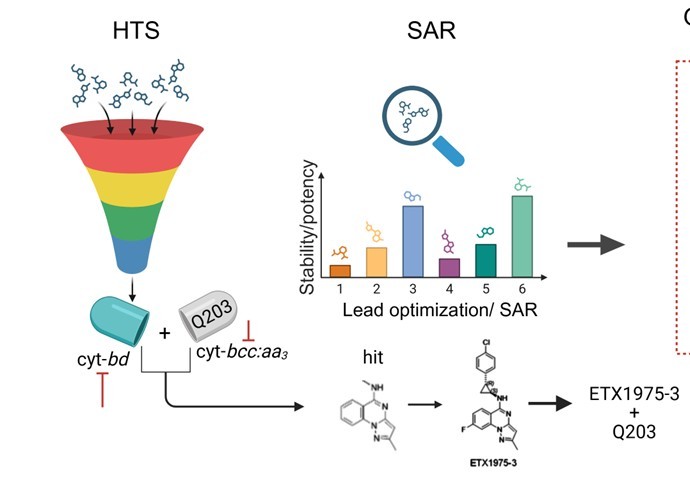
To generate adenosine triphosphate (ATP), TB bacteria rely on an oxidative phosphorylation pathway powered by two distinct terminal respiratory oxidases to pass electrons to oxygen and generate proton motive force required for ATP generation. Think of these as a primary energy circuit (the cytochrome bcc:aa₃ pathway) and a secondary backup generator (the cytochrome bd oxidase).
Tuberculosis Has Multiple Ways of Staying Alive
Mycobacterium tuberculosis is remarkably resilient. It can survive inside immune cells, tolerate low oxygen environments, and even slow its metabolism to tolerate modern antibiotic treatment.
Many antibiotics work best against rapidly growing bacteria. TB, however, can enter a low-energy dormant state where it becomes much harder to eliminate, thus delaying treatment for months instead of days.
The bacterium needs energy to survive but one way of targeting it is by the clinical-stage drug Q203 (telacebec). Unfortunately, it has a backup respiratory system called cytochrome bd oxidase. As long as that backup system works, the bacterium survives.
Attacking the Backup Generator
In an attempt to target the backup generator, researchers from LKCMedicine and Experimental Drug Discovery Consortium, Singapore validated and utlilized a screening system using living mycobacteria and tested more than 115,000 small molecules to find compounds. After extensive testing, the compound ETX1975-3 was developed.
ETX1975-3 is not effective on its own but when used in combination with Q203, they can shut down the bacterium’s survival respiratory routes.
During their experiments, the researchers found that when used as a combination, the drugs not only killed actively growing TB bacteria and also eliminated dormant, antibiotic-tolerant populations that have been particularly difficult to treat. This treatment combination was found to be effective against multiple clinical isolates especially Lineage 2 and 4 bacterium which are widely spread and dominant in East Asia/Beijing lineage, including multidrug-resistant and extensively drug-resistant strains. Biochemical experiments also confirmed that that ETX1975-3 directly interacts with cytochrome bd oxidase.
Beyond Tuberculosis
Crucially, this dual-targeting mechanism proved effective against highly dangerous, drug-tolerant clinical isolates, including Multi-Drug Resistant (MDR) and Extensively Drug-Resistant (XDR) TB strains. By revealing the precise molecular “off switch” for TB’s backup generator, this research provides an important biochemical strategy to shorten treatment times and defeat antibiotic resistance. As Cytochrome bd is conserved in other concerning mycobacterial pathogens, ETX-1975-3 was able to act against M. abscessus and M. avium also.
Why This Matters
The most important advance may not be ETX1975-3 itself but the strategy it represents.
TB survives because it has a backup energy system. This study demonstrates that blocking both the primary and alternative respiratory terminal oxidases, which suffocate bacilli and results in bactericidal potency.
What Next?
ETX1975-3 is still an early-stage preclinical drug candidate. More optimisation and safety studies are needed before human trials. This work provides strong proof of concept that disabling TB’s backup power supply could become a powerful new weapon against one of our oldest infectious diseases.