
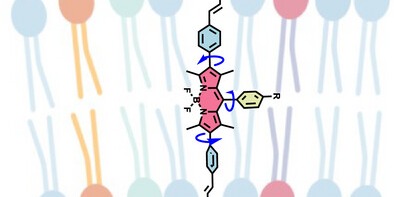
The paper by Dr Zhu Jiyu and collaborators introduce a new class of environmentally sensitive fluorescent conjugated oligoelectrolytes (COEs) that enable visualisation of temporal changes in live cells, providing not only spatial information on intracellular membranes but also on their physical properties such as membrane composition.
Membrane-intercalating conjugated oligoelectrolytes (COEs) are lipid-bilayer-spanning molecules that serve as fluorescent dyes for bioimaging. However, COE emission has thus far only been capable of visualising dye location and their preferential accumulation in different membrane-bound intracellular compartments. Herein, the authors report the first example of environmentally sensitive COEs for visualising temporal changes in live cells, providing information on the physical properties of intracellular lipid bilayer membranes. The new COE-BY series is designed around a BODIPY central unit with a membrane-spanning topology and six cationic pendant groups ensuring solubility in aqueous media. These reporters feature high two-photon absorption cross section, NIR-II excitation capabilities under multiphoton excitation, and high dye brightness; all highly desirable photophysical features for bioimaging.

The emission lifetime of the probes was found to be sensitive to changes to both the lipid composition of model vesicle systems and membrane tension within cells, induced by either mechanical or osmotic stress. Using two-photon fluorescence lifetime imaging microscopy, it is possible to use the most efficient emitter, namely, COE-BYPhOC4, to image changes in the mechanical properties of intracellular membranes. The authors show that these COEs remain stably vesicle-bound within the endolysosomal pathway over extended periods, allowing for long-term monitoring of the associated biophysical changes of these vesicles over time.
Read the paper here.