
Dr Geng Yuhao and Prof Atul Parikh
Single cells live with a continuous buzz of molecular noise. Both the stochastic nature of gene expression (intrinsic noise) and fluctuations in cellular resources (extrinsic noise) contribute to variability in molecular concentrations. How do cells cope with this heterogeneity? Liquid–liquid phase separation has been proposed as a mechanism for buffering concentration fluctuations. Yet how enzymatic reactions couple dynamically to molecular exchange across phase boundaries remains poorly understood.
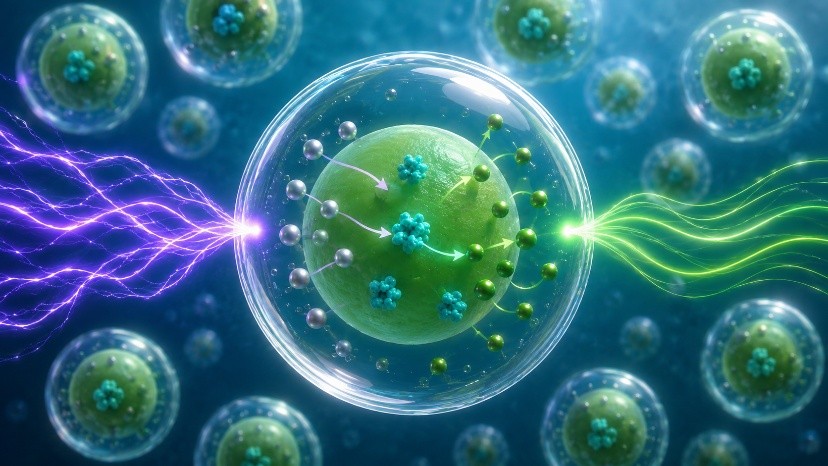
To investigate these coupled processes, Dr. Geng Yuhao, along with Prof Atul Parikh, developed coacervate-containing droplets (CCDs) as a controllable platform, as described in the paper ‘Biphasic Enzymatic Reaction in Coacervate-containing Droplets’, published in Nature Communications.
Creating arrays of coacervate-containing droplets
Using droplet microfluidics, the researchers generated thousands of monodisperse aqueous droplets, each containing a single coacervate formed from oppositely charged polyelectrolytes. This architecture provides discrete, parallel reaction compartments in which the partitioning of molecules between the coacervate and surrounding dilute phase can be quantitatively measured.
The enrichment of guest molecules is scaffold polyelectrolyte stoichiometry-dependent
Dense phase formed by scaffold polyelectrolytes is known for the ability to enrich or exclude guest molecules. However, small molecules and proteins can exhibit strongly different partitioning behaviors depending on their physicochemical properties and the stoichiometry of oppositely charged scaffold polyelectrolytes in the condensed phase.
Enzymatic reaction regulation and reaction noise buffering in the coacervate phase
Alkaline phosphatase–mediated dephosphorylation of fluorescein diphosphate is applied as a model reaction to examine how molecular enrichment affects enzymatic chemistry.
Importantly, the enhanced product accumulation observed inside coacervates cannot be explained by local reaction alone. Experiments and reaction–mass-transfer model show that enzymatic conversion and interphase molecular transport are tightly coupled: preferential partitioning concentrates reactants and increase the apparent enzymatic reaction rate, while reaction-driven fluxes redistribute products between the two phases. Although the coacervate occupies only a small fraction of the droplet volume, it can contribute disproportionately to product formation. The coacervate phase also buffers reaction noise from fluctuations in substrate availability, maintaining relatively stable reaction rates under external substantial perturbations.
Epilogue
Together, these findings establish CCDs as a quantitative model for understanding how phase separation, enzymatic kinetics and molecular transport work together to regulate biochemical reactions. More broadly, the study highlights that chemically active condensates should be viewed not simply as passive reaction vessels, but as dynamic, nonequilibrium compartments whose continual exchange with their surroundings can reshape biochemical function.
This study was conducted in collaboration with colleagues from Tsinghua University. Read the paper here.